House Moving Services in Cairns
Licensed structural transport for homes across Cairns and Far North Queensland.
Available Mon-Fri 7am-5pm and Sat 8am-12pm.
What House Moving Involves and When You Need It
Damon House Relocators is a QBCC-licensed house moving and structural relocation specialist serving Cairns, Far North Queensland, and surrounding regions since 1998.
House moving is the process of physically lifting a building from its footings, transporting it along a permitted road route, and setting it down on new or prepared foundations at a different location. It is a significant undertaking that involves structural engineering, government approvals, road transport logistics, and utility coordination. This is not a task for a general builder or a removalist company.
Five situations typically drive demand for a full structural house move. First, property subdivision where the existing dwelling must shift to a new position within the subdivided lot to meet setback requirements or create a clear title. Second, the sale of a home to a buyer who wants it relocated to a different property entirely. Third, a dwelling facing demolition that still holds structural integrity and financial value. Fourth, a home that needs to vacate a development site to allow new construction to proceed. Fifth, a rural or remote-area relocation where the existing structure is in good condition and the cost of moving it is lower than the cost of building new.
In every one of these situations, the work requires a licensed contractor. Queensland law is clear on this point. If you are at the stage of considering whether a house move is the right path, the right next step is a structural site assessment.
House moving involves lifting a building off its footings using hydraulic jacks, loading it onto a purpose-built low-loader transport vehicle, and relocating it to a prepared foundation at a new site. The process includes council development approvals, road transport permits, utility clearances, and structural preparation. A QBCC licence is required for this work in Queensland.
How a House Move Works From Start to Finish
Initial Site Assessment and Structural Evaluation
We inspect the building in place to assess its structural condition, frame type, and suitability for relocation. This evaluation determines the preparation scope and informs every permit and logistics step that follows.
Council Development Approval and Building Certification
We coordinate the development approval (DA) application with Cairns Regional Council or the relevant local authority. A building permit for the receiving site is also required, and we manage that process as part of the job.
Road Transport Permitting and Route Assessment
We arrange over-dimension vehicle permits for the transport route, including height, width, and load assessments. Route selection accounts for overhead powerlines, bridge load ratings, and road geometry across the FNQ network.
Police Escort Coordination and Traffic Management
For most house moves, a police escort and traffic management plan are required for public road transit. We organise these arrangements directly and build them into the project schedule so the move proceeds without delay.
Utility Line Clearances With Ergon Energy, NBN, and Telco Providers
We contact Ergon Energy, NBN, and telecommunications providers to arrange temporary line lifts or disconnections along the transport route. Clearances must be confirmed before the move date is locked in.
Service Disconnection at the Origin Site
Water, power, and sewerage connections at the existing site are disconnected and made safe before structural preparation begins. This step is coordinated with the relevant service providers and is non-negotiable before any lift work commences.
Structural Preparation of the Building
Steps, verandahs, external protrusions, and any elements that would exceed transport envelope dimensions are removed or temporarily detached. This work is carried out carefully to allow reinstatement at the new site.
Hydraulic Lifting Onto the Transport Vehicle
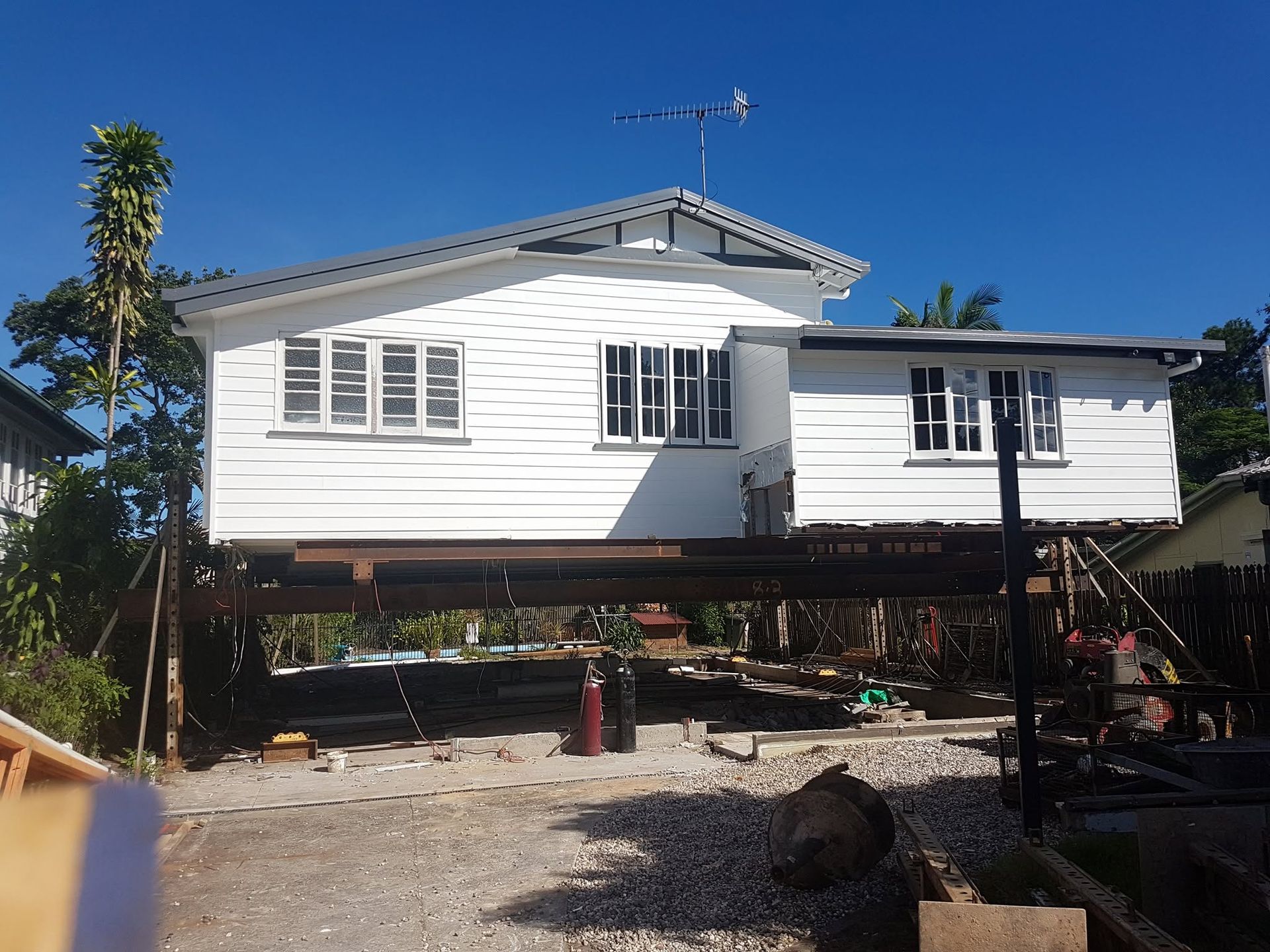
We use hydraulic jacking systems to lift the structure off its footings and load it onto a purpose-built low-loader transport vehicle. This is the highest-risk stage of the move and demands precision that only comes from experience.
Road Transit Along the Approved Route
The building travels along the pre-approved route with all required escorts and traffic management in place. Transit is typically completed in a single overnight or early-morning movement to minimise disruption on public roads.
Placement on New Foundations and Re-Levelling
We set the building down on the prepared foundations at the new site and re-level the structure to specification. This is the point at which the building is ready for reconnection of services and any reinstatement of external elements.
Structures We Can and Cannot Relocate
Timber-Framed Homes Suitable for Relocation
Traditional Queenslanders are well suited to relocation because their elevated timber frame separates cleanly from the subfloor structure beneath. Post-war timber cottages share the same characteristic and are routinely relocated across FNQ. Timber-framed residential homes of most eras are eligible provided the frame is structurally sound. Modular buildings are designed with transport in mind and present a straightforward relocation case in most situations. Steel-framed structures are also relocatable, with the structural assessment confirming load distribution and lifting points before any work begins.
Structures That Cannot Be Relocated
Slab-on-ground concrete structures cannot be relocated. The concrete slab is the foundation itself, not a separable floor system, and there is no practical way to lift and transport the building without demolishing the slab. Any separation attempt would destroy the structural integrity of the building. If you own a slab-on-ground home and are unsure whether it qualifies for relocation, call us for a site assessment before drawing any conclusions.
Licensed, Insured, and Experienced Across Far North Queensland
We hold QBCC Licence #733646. Queensland law requires a QBCC licence for structural building relocation work, and we encourage every homeowner to verify this number on the QBCC public register before engaging any contractor. In the context of house moving, transporting a structure on a public road without a licensed contractor does not just risk a poor outcome on the day. It exposes the homeowner to significant legal and financial liability if anything goes wrong during transit, and insurance claims can be voided if unlicensed work is involved.
Every house move we undertake carries structural transit insurance, public liability insurance, and contract works insurance. Structural transit insurance protects the building itself during physical relocation from origin site to destination. Public liability insurance covers third-party property damage and personal injury risk along the transport route and at both sites. Contract works insurance covers the job from the moment we commence structural preparation through to final placement and completion.
We have 28 years of house moving experience across Cairns and Far North Queensland. Alan Damon founded the business in 1998. Richard Damon works alongside him now, bringing a second generation of hands-on FNQ structural relocation experience. The third generation of the Damon family is already learning the trade. That continuity matters in this work because the knowledge of local road networks, council processes, and FNQ building stock is accumulated over decades, not obtained from a manual.
28 Years
FNQ House Moving Experience
QBCC #733646
Verified Licence Number
3 Generations
Family Business Since 1998
Common Questions About House Moving in Cairns
These are the questions we hear most often from homeowners and real estate agents before they call us about a house move.
What types of houses can be relocated in Far North Queensland
Timber-framed homes are the most common candidates. Traditional Queenslanders, post-war timber cottages, and modular buildings can all be moved. Steel-framed structures are also relocatable in most cases. Slab-on-ground concrete homes cannot be moved because the concrete slab is the foundation, not a separable floor system. If you are unsure, call us for a site assessment.
Do I need council permits to move a house in Cairns
Yes. A development approval (DA) from Cairns Regional Council is required before a house can be moved, along with a building permit for the new site. We coordinate the permit process as part of the job, including road transport permits and any police escort requirements. We have navigated this process in Far North Queensland for over 28 years.
Does Damon House Relocators offer furniture removal or standard removalist services
No. We specialise in structural building relocation. We physically move the building itself, not its contents. We do not offer furniture removal, packing services, or standard household removalist work. If you need a furniture removalist, you will need to arrange that separately before we begin structural preparation on the building.
Is Damon House Relocators fully licensed and insured for house moving
Yes. We hold QBCC Licence #733646, which is required under Queensland law for structural building relocation. Every house move we undertake carries structural transit insurance, public liability insurance, and contract works insurance. You can verify our QBCC licence number on the Queensland Building and Construction Commission public register.
How long does a house move take from start to finish in Cairns
The timeline depends on the distance, permit processing time, and site preparation requirements. Most house moves in the Cairns region take between four and ten weeks from initial assessment to final placement, with permit coordination typically accounting for the majority of the lead time. We give every client a realistic timeline during the assessment.
Talk to Us About Moving Your Home Across Cairns or FNQ
Damon House Relocators has managed licensed house moving and structural building relocation across Cairns and Far North Queensland since 1998 - from council development approvals to final placement on new foundations.
Available Monday to Friday 7:00am-5:00pm and Saturday 8:00am-12:00pm.